

White Goods Plastic Recovery and PCR Market to Reach USD 6,474.5 Million by 2036, Driven by Circular Economy Mandates
White Goods Plastic Recovery and PCR Market
USA white goods plastic recovery and PCR plastics are rising at 11% CAGR as appliance makers adopt recycled content to meet rules and eco-conscious demand.
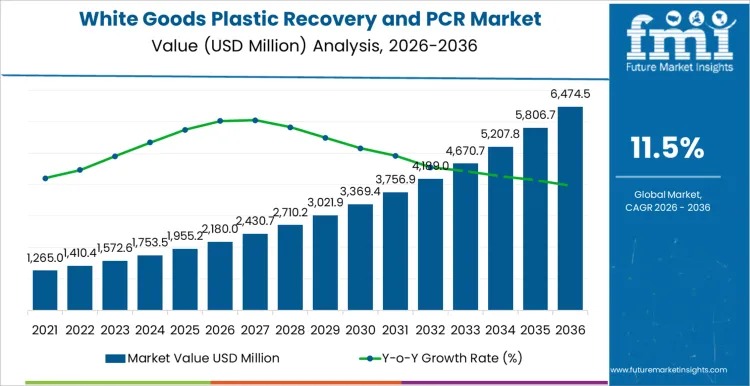
NEWARK, DE, UNITED STATES, January 20, 2026 /EINPresswire.com/ -- The global white goods plastic recovery and PCR plastics market is entering a decade of accelerated growth, supported by tightening government regulations, extended producer responsibility (EPR) frameworks, and rising demand for circular materials in appliance manufacturing. The market is forecast to be valued at USD 2,180.0 million in 2026 and is projected to reach USD 6,474.5 million by 2036, expanding at a compound annual growth rate (CAGR) of 11.5%.
This outlook reflects how appliance manufacturers worldwide are adapting to regulatory compliance requirements while integrating recovered plastics into new products such as refrigerators, washing machines, and air conditioners. Growth is particularly pronounced in regions strengthening plastic waste management systems and enforcing recycled content targets.
Explore Opportunities – Get Your Sample of Our Industry Overview Now!
https://www.futuremarketinsights.com/reports/sample/rep-gb-31550
Market Overview: Regulatory Pressure Shapes Recovery and PCR Demand
The white goods plastic recovery and PCR market focuses on reclaiming plastics from end-of-life household appliances and reintegrating them into manufacturing cycles. Governments across major economies are implementing policies that directly affect how plastics from white goods are collected, recycled, and reused.
In India, plastic waste management rules mandate extended producer responsibility for producers, importers, and brand owners. These entities must meet collection and recycling targets and submit annual compliance reports to the Ministry of Environment, Forest and Climate Change, with penalties imposed for non-compliance.
The European Union enforces recycling and recovery targets through the Waste Framework Directive and the Packaging and Packaging Waste Directive. These regulations promote recyclability and minimum recycled content requirements, including for white goods packaging.
In the United States, federal and state authorities are developing EPR laws for electronics and appliances, emphasizing plastic collection, recycling infrastructure, and compliance reporting. China has reinforced domestic recycling by restricting plastic waste imports, encouraging recovery of plastics for use in sectors such as white goods manufacturing.
Quick Market Facts
• Market Value (2026): USD 2,180.0 million
• Forecast Value (2036): USD 6,474.5 million
• CAGR (2026–2036): 11.5%
• Leading End Use: Large home appliances
• Fastest-Growing Countries: India, China, Brazil, USA, Germany
• Key Demand Drivers: Regulation, EPR compliance, circular economy targets
End-Use and Appliance Segmentation Highlights
Large Home Appliances Lead Recovery Volumes
Large home appliances account for 45.0% of total demand, reflecting the significant plastic volumes generated by refrigerators, washing machines, and similar equipment at end of life. These appliances offer predictable material streams that support organized dismantling and recovery.
Key insights:
• High-volume appliances generate consistent recoverable plastics
• Remanufacturing extends product and material lifecycles
• EPR systems improve participation in structured recovery programs
Refrigerators and Washing Machines Dominate Appliance Segments
Refrigerators and washing machines represent 38.0% of recovered plastic demand, driven by standardized designs and polymer consistency that support automated dismantling.
Key insights:
• Standardized appliance designs enable predictable recovery workflows
• Mixed appliance streams require advanced sorting technologies
• High-volume dismantling lines improve recovery efficiency
Polymer Landscape: PCR-ABS and PCR-PP at the Core
PCR-ABS and PCR-PP account for 55.0% of recovered polymer output, reflecting their widespread use in appliance housings and internal components. These polymers balance mechanical strength, recyclability, and compatibility with closed-loop manufacturing.
• PCR-ABS and PCR-PP dominate recovered material supply
• Engineering plastics support higher-performance applications
• Polymer blends address durability and thermal stability requirements
Global Trade Dynamics in Recovered Plastics
The white goods plastic recovery market reflects broader global trade flows in recycled plastics. China, the United States, and Vietnam rank among the largest exporters of recycled plastic, supplying PCR pellets and scrap to international buyers. South Korea and Malaysia are also significant exporters.
On the import side, the United States, China, and India lead demand, supported by large domestic manufacturing bases. Turkey and Malaysia remain important importers following shifts in global trade after China’s waste import restrictions. European countries import specific grades of recycled plastics to meet rising PCR content requirements.
Regional Growth Outlook
Global demand is rising as appliance manufacturers align sustainability goals with regulatory compliance. Country-level CAGR forecasts include:
• India: 15.2%
• China: 13.8%
• United States: 11.0%
• Germany: 10.6%
• Japan: 9.6%
India’s growth reflects stronger waste management infrastructure and local recycling capacity, while China’s expansion is driven by government-led recycling initiatives. In the United States and Germany, stricter regulations and consumer demand for sustainable products support adoption. Japan’s growth is underpinned by investment in recycling technology and eco-conscious consumer behavior.
Competitive Landscape: Focus on Quality and Recovery Efficiency
The market is characterized by companies enhancing recovery rates, improving polymer separation, and delivering high-quality PCR materials suitable for appliance manufacturing.
Key players include:
• BSH Recycling
• MBA Polymers
• WM Plastics Recovery
• Eastman
• GEM Co.
• TCL Circular
• Panasonic Eco Technology
• DOWA
Competitive differentiation is based on processing efficiency, contamination control, scalability, and compliance with environmental regulations. Buyers prioritize suppliers capable of delivering consistent PCR quality aligned with appliance performance requirements.
Outlook: Circularity and Compliance Drive Long-Term Growth
The white goods plastic recovery and PCR market is positioned for sustained expansion as manufacturers balance regulatory compliance, cost considerations, and sustainability commitments. Ensuring consistent material quality, investing in advanced sorting technologies, and aligning with extended producer responsibility systems will remain critical to market development through 2036.
As appliance lifecycles shorten and circular economy frameworks mature, recovered plastics from white goods are expected to play an increasingly central role in reducing plastic waste and supporting sustainable manufacturing globally.
Why FMI: https://www.futuremarketinsights.com/why-fmi
Related Reports Insights from Future Market Insights (FMI)
Clear Floor Tiles Market https://www.futuremarketinsights.com/reports/clear-floor-tiles-market
Recarburizers Market https://www.futuremarketinsights.com/reports/recarburizers-market
Dimethylolpropionic Acid (DMPA) Market https://www.futuremarketinsights.com/reports/dimethylolpropionic-acid-market
Micronized Silicon Market https://www.futuremarketinsights.com/reports/micronized-silicon-market
About Future Market Insights (FMI)
Future Market Insights, Inc. (FMI) is an ESOMAR-certified, ISO 9001:2015 market research and consulting organization, trusted by Fortune 500 clients and global enterprises. With operations in the U.S., UK, India, and Dubai, FMI provides data-backed insights and strategic intelligence across 30+ industries and 1200 markets worldwide.
Sudip Saha
Future Market Insights Inc.
+1 347-918-3531
email us here
Legal Disclaimer:
EIN Presswire provides this news content "as is" without warranty of any kind. We do not accept any responsibility or liability for the accuracy, content, images, videos, licenses, completeness, legality, or reliability of the information contained in this article. If you have any complaints or copyright issues related to this article, kindly contact the author above.
