

How to Choose Takeaway Food Containers for Hot Meals: A Complete Guide for Restaurants by Grizzlies
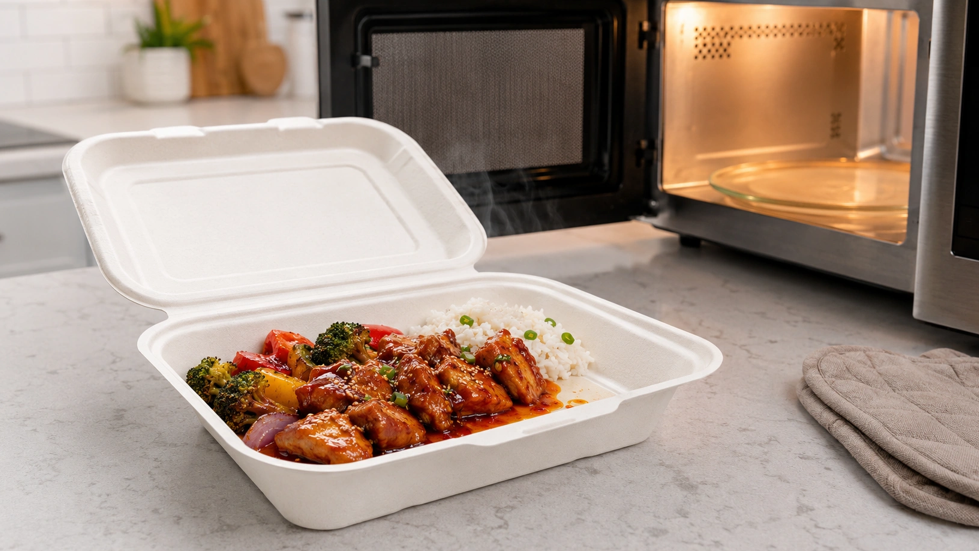

The best container depends on the actual menu. Soup, noodles, fried food and heavy rice meals create very different packaging demands, so professional buyers should match the container structure, barrier performance and lid design to the intended food application before placing a bulk order.
For high-volume programs, working directly with an experienced takeaway food container manufacturer also gives buyers greater control over product specifications, OEM customization, quality consistency and factory-direct pricing.
What Makes Hot Food Packaging Different?
Hot takeaway food creates several packaging challenges at the same time. Freshly cooked meals release steam and condensation inside the container. Oily dishes and sauces place additional pressure on grease and liquid barriers, while multiple orders stacked inside courier bags require strong sidewalls, rims and bases.
Packaging selected for the wrong application can result in:
• softened or deformed containers;
• sauce or oil leakage;
• poor lid fit;
• crushed meals during stacking;
• excessive condensation;
• customer complaints and replacement orders.
The practical solution is not to use one generic container for every menu item. Instead, buyers should choose packaging according to food temperature, moisture level, grease content, holding time and delivery conditions.
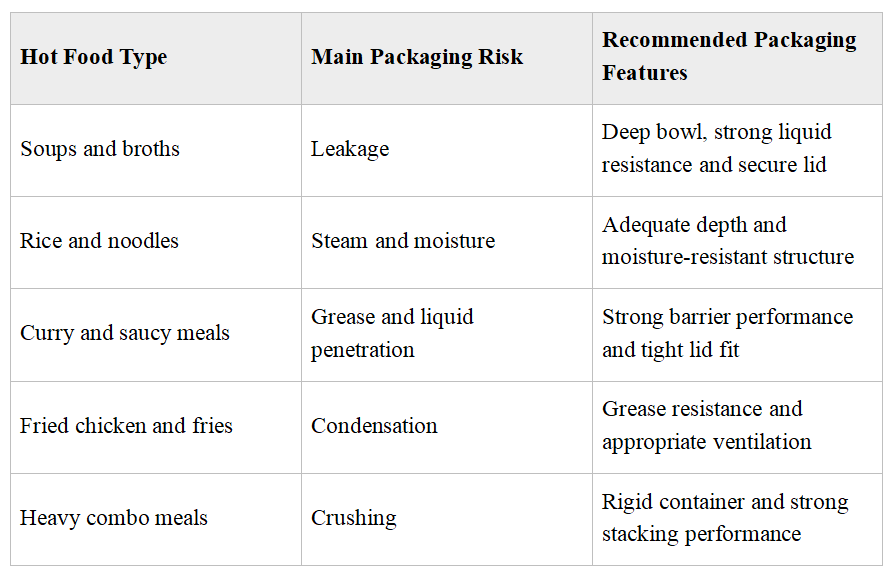
How to Match Containers to Different Hot Meals
Different hot foods require different packaging structures. The right combination of container depth, barrier performance, lid fit and ventilation can significantly improve delivery performance.
Molded sugarcane bagasse is a strong option for many hot-food applications because it provides good rigidity, a premium natural-fiber appearance and reliable foodservice performance.
For foods with higher grease, moisture or sealing requirements, buyers can also select PFAS-free barrier-coated or laminated bagasse structures for enhanced performance.
Five Technical Factors Buyers Should Check
When evaluating takeaway containers for hot food, professional buyers should focus on five critical factors: heat performance, grease and liquid resistance, lid fit, stacking strength, and verified food-contact compliance.
1. Heat Performance
Hot-food containers need to maintain their shape when filled with freshly cooked meals. Buyers should consider the complete use scenario, including hot filling, takeaway holding time, reheating, microwave use, and chilled or frozen storage where required.
Molded-fiber packaging is widely used for demanding hot-food service, while specific microwave, freezer or oven requirements can be matched to the selected product structure.
2. Grease and Liquid Resistance
Oil and moisture resistance are especially important for fried foods, curries, pasta sauces and other high-fat or sauce-heavy dishes. Standard pulp fiber works well for many foodservice applications. For more demanding meals, enhanced PFAS-free barrier systems, coatings or laminated structures can provide stronger grease and moisture resistance.
The correct structure should be selected according to the food type, temperature and expected delivery time.
3. Lid Fit and Spill Protection
A strong container base cannot compensate for a poorly fitting lid. For soups, sauces and delivery meals, buyers should evaluate lid engagement, rim consistency, resistance to movement and stacking compatibility.
A secure lid helps reduce spill risk during transport and improves the overall customer experience.
4. Stacking Strength
Delivery drivers often carry several meals in one insulated bag. Weak containers can deform under vertical pressure and damage both the food and presentation.
Molded sidewalls, reinforced rims and stable bases help containers maintain their shape during stacking and handling. For restaurant chains and high-volume delivery programs, stacking performance should be tested using fully loaded containers, not only empty samples.
5. Food-Contact and PFAS Compliance
Professional foodservice buyers increasingly expect suppliers to provide clear product documentation rather than relying only on broad claims such as “food-safe” or “PFAS-free.”
For international procurement, buyers should request the relevant food-contact documentation, PFAS testing and product specifications required by the target market.
European requirements are also becoming stricter. Regulation (EU) 2025/40 introduces specific PFAS limits for food-contact packaging from 12 August 2026, making supplier documentation and product-level verification increasingly important for European buyers.
Total Operational Cost Matters More Than Unit Price
Buying the cheapest takeaway container can create hidden costs if the packaging performs poorly during service or delivery.
Packaging failure costs can include spills, refunds, replacement meals, damaged delivery bags and last-minute replacement purchases.
For example, saving a small amount per container may have little value if repeated leakage results in refunded orders or negative customer reviews.
High-volume foodservice buyers should therefore compare container performance, freight and packing efficiency, MOQ, storage requirements, packaging failure risk and supply stability.
Working directly with a factory-direct takeaway packaging manufacturer can also improve pricing transparency, reduce intermediary markups and give buyers direct access to the technical and production teams.
Testing real food also helps buyers determine the correct container depth, portion size, compartment layout and lid structure.
For OEM projects, this stage is particularly valuable because structural or barrier adjustments can be completed before mass production.
Why Work Directly with a Source Manufacturer?
For restaurant groups, distributors and private-label packaging buyers, direct factory access offers more than competitive pricing.
Grizzlies operates 11 production bases with 280+ automated machines and supports up to 200 × 40HQ of monthly production capacity. With 15+ years of OEM/ODM manufacturing experience, the company supports both bulk production and customized takeaway packaging programs.
As a top 10 factory-direct bagasse food packaging manufacturer in China, Grizzlies can support:
• BRC certified, BPI certified, OK Compost certified and FSC certified food packaging solutions;
• FDA compliant and LFGB compliant food-contact packaging;
• custom molds and dimensions;
• logo embossing and private-label projects;
• customized bowls, trays and clamshells;
• PFAS-free barrier solutions;
• coated and laminated bagasse options;
• product sample development;
• in-house production coordination and quality control.
Direct communication with the manufacturing team makes it easier to adjust product structures, confirm technical requirements and move efficiently from sample development to bulk production.
What Buyers Should Check Before Ordering
• Define the food type, temperature, grease level and delivery time.
• Choose the container structure according to the actual menu.
• Test leakage, grease resistance, lid fit and stacking performance.
• Confirm whether standard, coated or laminated bagasse is required.
• Verify relevant food-contact and PFAS documentation.
• Compare total operational cost rather than unit price alone.
• Audit factory capacity, QC and OEM/ODM capability before scaling.
Conclusion
The best takeaway food container is the one that performs reliably with the actual meal.
For hot-food programs, buyers should focus on heat performance, grease and liquid resistance, lid fit, stacking strength and real-world delivery testing rather than selecting packaging only by material or price.
Molded bagasse provides a versatile solution for many hot takeaway applications, while coated and laminated structures offer additional options for more demanding food requirements.
For large-volume purchasing, working directly with a source manufacturer also provides stronger control over customization, quality, pricing and long-term supply.
Grizzlies supports factory-direct takeaway food packaging, OEM/ODM development and bulk customized projects. Buyers can request product samples, specifications, compliance documentation and factory-direct quotations before placing a production order.
Shenzhen Grizzlies Industries Co.,LTD
Shenzhen Grizzlies Industries Co.,LTD
+86 137 1519 2986
email us here
Legal Disclaimer:
EIN Presswire provides this news content "as is" without warranty of any kind. We do not accept any responsibility or liability for the accuracy, content, images, videos, licenses, completeness, legality, or reliability of the information contained in this article. If you have any complaints or copyright issues related to this article, kindly contact the author above.
