

BRC, BSCI, BPI and OK Compost: What Foodservice Packaging Buyers Need to Know and What Grizzlies Can Offer

Key Takeaways
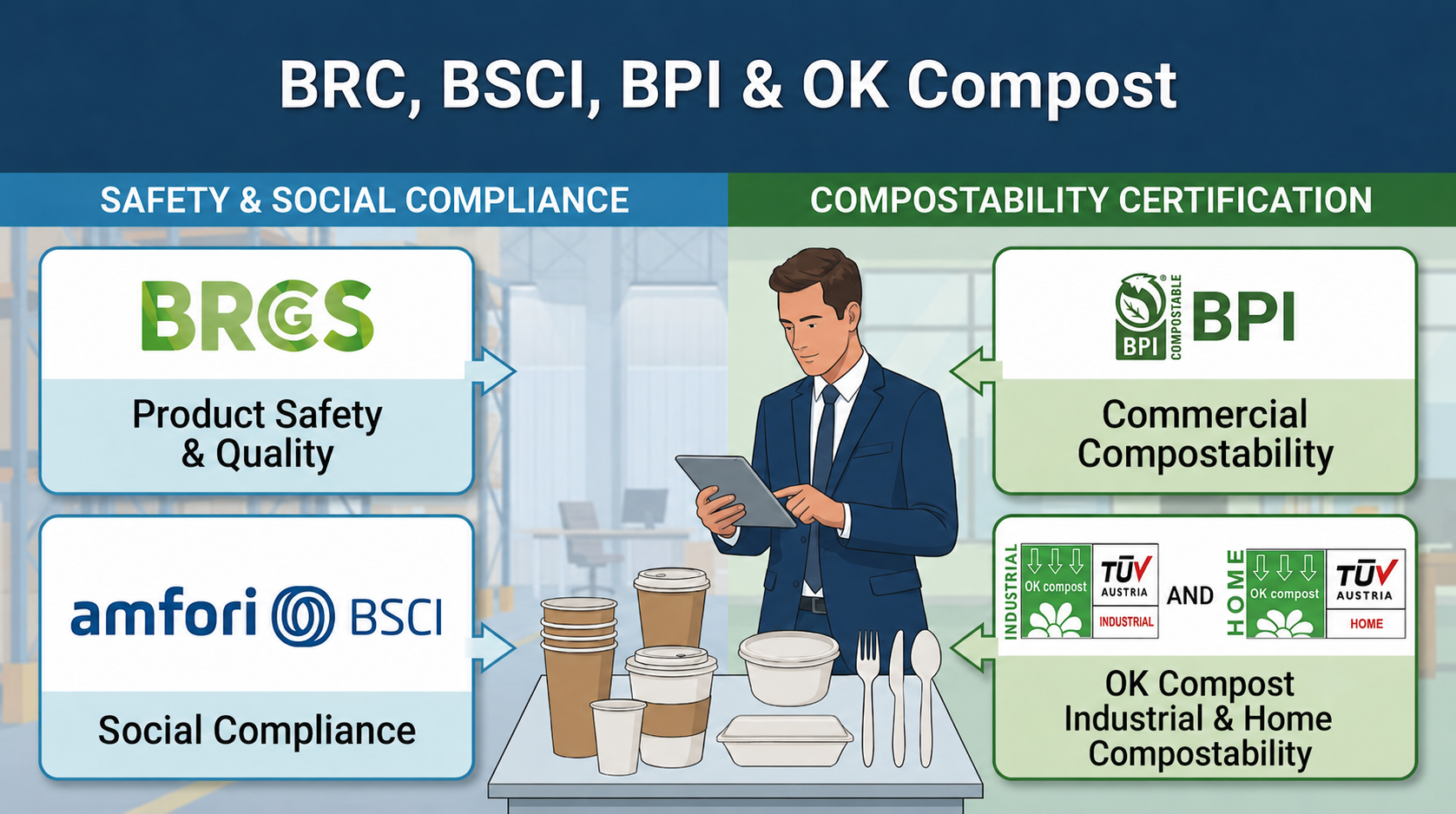
BRCGS Global Standard Packaging Materials Issue 7 evaluates site-level quality, product-safety, legality and operational controls; amfori BSCI evaluates social performance at the manufacturing site.
BPI and OK compost are product-level compostability certifications and should be verified against the exact product, formulation or SKU.
BPI distinguishes Commercial Only from Commercial & Home certification, while OK compost INDUSTRIAL and OK compost HOME are separate TÜV AUSTRIA certification schemes.
Buyer approval files should separate factory evidence, product certification scope, food-contact compliance and market-specific chemical requirements such as EU PFAS limits.
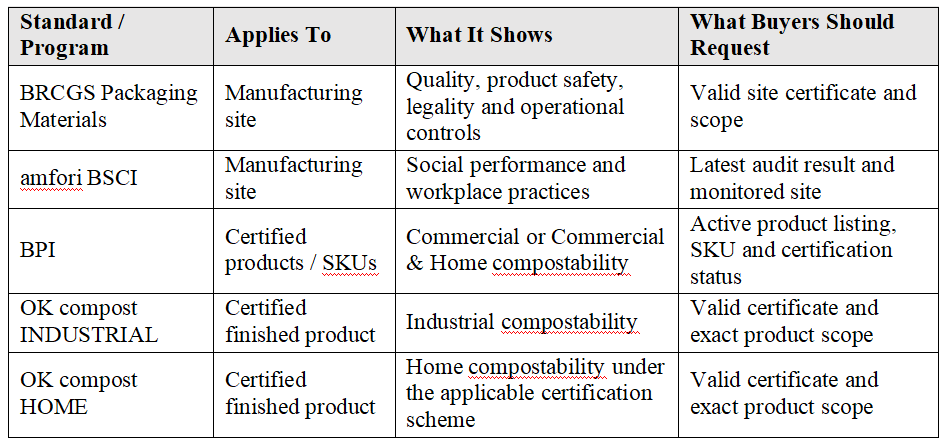
BRC, BSCI, BPI and OK Compost at a Glance
Standard / Program Applies To What It Shows What Buyers Should Request
BRCGS Packaging Materials Manufacturing site Quality, product safety, legality and operational controls Valid site certificate and scope
amfori BSCI Manufacturing site Social performance and workplace practices Latest audit result and monitored site
BPI Certified products / SKUs Commercial or Commercial & Home compostability Active product listing, SKU and certification status
OK compost INDUSTRIAL Certified finished product Industrial compostability Valid certificate and exact product scope
OK compost HOME Certified finished product Home compostability under the applicable certification scheme Valid certificate and exact product scope
What Does BRC Packaging Materials Mean?
BRC Global Standard Packaging Materials Issue 7 is a site-level standard for quality, product safety, legality and manufacturing controls. It matters to foodservice, retail and private-label buyers because it provides an independent framework for assessing site risk management.
For a sourcing review, buyers should check the legal company name, manufacturing-site address, certificate validity, scope and current issue. A BRC certificate does not make every product compostable; it verifies the manufacturing site's management and operational system.
What Does an amfori BSCI Audit Cover?
amfori BSCI is not a product certification. It is a social performance monitoring system used to assess manufacturing sites on topics such as working conditions, occupational health and safety, working hours, remuneration and other responsible-sourcing requirements.
For B2B buyers, the practical value is supply-chain transparency. Buyers should request the latest available audit result for the actual factory producing the order and confirm that the monitored site matches the proposed production location.
What Does BPI Certification Mean?
BPI certification is product-level evidence for compostability. BPI currently offers Commercial Only Certification and Commercial & Home Certification. Commercial certification uses ASTM D6400 as its base standard, while BPI's Home Compostability Certification Program, launched in 2025, adds a separate home-composting assessment.
This distinction matters for procurement. A supplier may manufacture many bagasse products, but only products covered by the active certification scope should be marketed as BPI certified. Buyers can verify certified items by company, product name or item number in BPI's product catalog.
OK Compost INDUSTRIAL vs OK Compost HOME
TÜV AUSTRIA's OK compost marks distinguish industrial compostability from home compostability. OK compost INDUSTRIAL is intended for products certified for industrial composting conditions. OK compost HOME is a separate certification for products assessed for home-composting conditions.
One mark should not be used as proof of the other. Buyers should therefore match the certificate number and product description to the exact plate, bowl, tray, clamshell or other item being purchased. This is especially important when coatings, inks, labels or laminated structures change the finished product.
Factory-Level vs Product-Level Evidence
The simplest way to avoid certification confusion is to separate factory evidence from product evidence. Factory-level evidence includes BRC Packaging Materials and amfori BSCI audit records. These documents help buyers evaluate the manufacturing site, management systems and responsible-sourcing practices.
Product-level evidence includes BPI and OK compost certificates. These should be checked against the specific finished product, formulation or SKU. Certification held by one item should not automatically be applied to every item made at the same factory.
What Other Compliance Documents May Buyers Need?
The compliance file should be built around the target SKU, material structure and destination market. For B2B sourcing, the most useful evidence usually falls into the following groups:
PFAS Compliance (EU PPWR): Regulation (EU) 2025/40 Article 5 applies from 12 August 2026 and sets 25 ppb for any targeted PFAS, 250 ppb for the sum of targeted PFAS, and 50 ppm for total PFAS including polymeric PFAS. Request SKU- and material-specific test evidence.
European Market (PPWR / REACH): PPWR Article 5 caps the combined concentration of lead, cadmium, mercury and hexavalent chromium at 100 mg/kg. REACH Regulation (EC) No 1907/2006 and food-contact requirements under Regulation (EC) No 1935/2004 and GMP Regulation (EC) No 2023/2006 may also apply depending on material and intended use.
US Market (FDA): FDA food-contact requirements should be assessed against the intended food type and condition of use, including temperature, contact time and whether the article is single-use or repeat-use.
Project-Specific Evidence: FSC documentation where applicable, material specifications, migration or performance test reports, coating/ink/lid declarations and change-control records may be needed to complete the buyer's approval file.
What Buyers Should Verify Before Ordering
Check certificate validity and expiry date.
Match the company name and manufacturing-site address.
Confirm that the specific product or SKU is inside the certification scope.
Verify whether the compostability claim is commercial, home, or both.
Request supporting test reports or product listings where relevant.
Record any coating, printing, lid or material changes that may affect the certified structure.
What Grizzlies Can Offer Foodservice Packaging Buyers
Grizzlies combines 15+ years of OEM/ODM experience with 11 production bases, 280+ automated machines and capacity of up to 200 × 40HQ per month. Compliance support is tied to the actual factory, product structure and destination market—not a generic certificate bundle.
Provide applicable BRC site certificates and amfori BSCI audit records for supplier qualification.
Match BPI or OK compost evidence to the exact finished product, formulation or SKU.
Support market-specific food-contact, PFAS and related compliance documentation for the selected structure.
Review custom coatings, printing, lids and material changes before bulk production to protect certificate applicability.
Supply samples and specifications for buyer approval before mass production.
For custom bagasse bowls, plates, trays and clamshells, the technical team can align the requested design with the intended certification and compliance file before production approval.
Buyers can request certification documents, product samples and a factory-direct quotation for the target SKU and market.
Shenzhen Grizzlies Industries Co.,LTD
Shenzhen Grizzlies Industries Co.,LTD
+ +86 137 1519 2986
email us here
Legal Disclaimer:
EIN Presswire provides this news content "as is" without warranty of any kind. We do not accept any responsibility or liability for the accuracy, content, images, videos, licenses, completeness, legality, or reliability of the information contained in this article. If you have any complaints or copyright issues related to this article, kindly contact the author above.
