

Returnable Packaging Market to Reach USD 234.16 Billion by 2035 at 6.78% CAGR
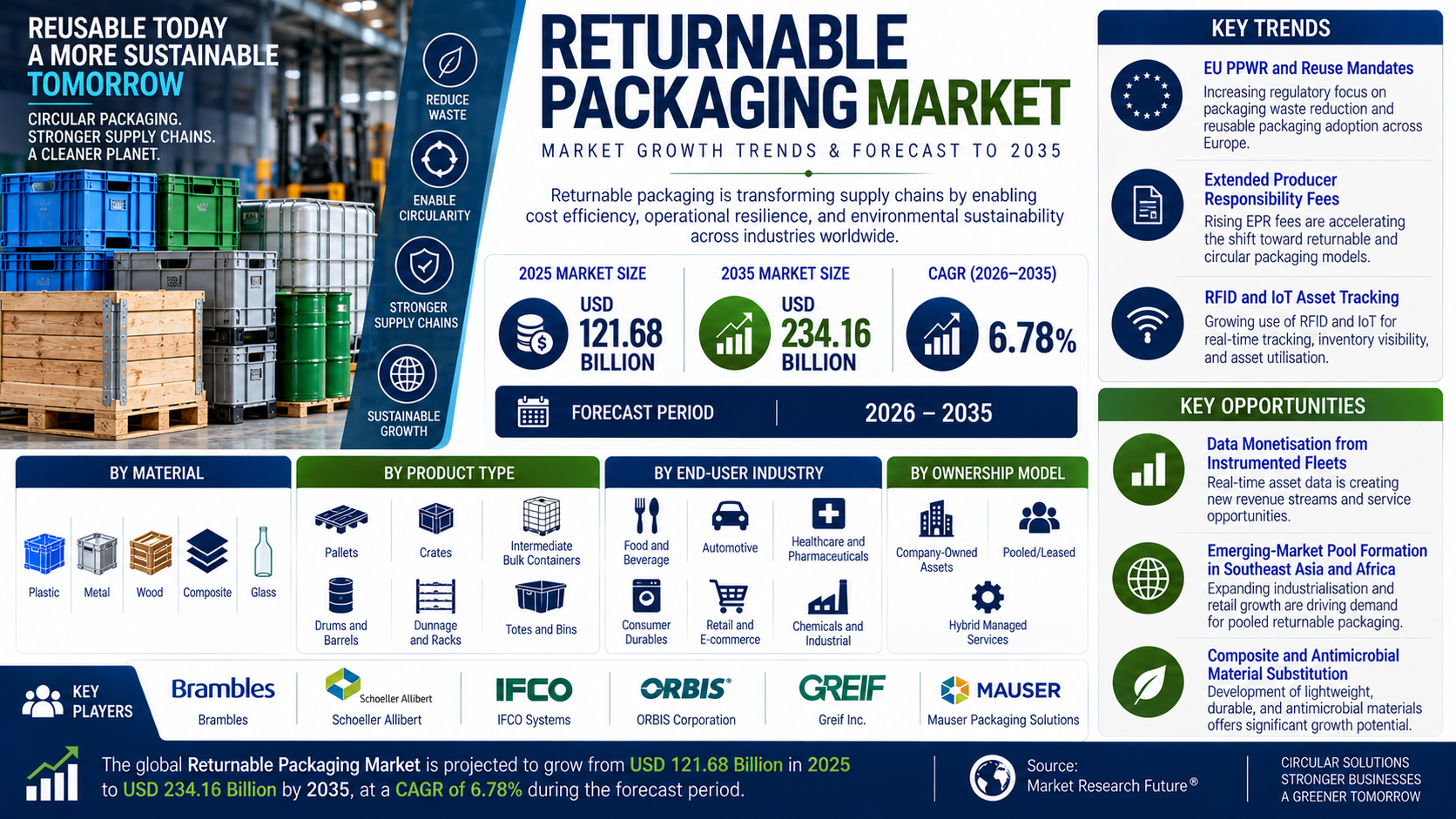
The returnable packaging market is expanding as reuse mandates, EPR fees and digital asset tracking accelerate sustainable supply-chain practices.
Reuse mandates, digital tracking and supply-chain efficiency are accelerating adoption of returnable packaging across industries.”
NY, UNITED STATES, September 17, 2026 /EINPresswire.com/ -- The global returnable packaging market was valued at USD 121.68 Billion in 2025 and is projected to reach USD 234.16 Billion by 2035, registering a CAGR of 6.78% during the 2026–2035 forecast period, according to Market Research Future®. The market is being shaped by regulatory pressure to increase packaging reuse, extended producer responsibility requirements, supply-chain efficiency initiatives and growing adoption of digital technologies for tracking reusable assets.— Market Research Future
Returnable packaging is designed for repeated use across distribution cycles, helping businesses reduce reliance on single-use packaging while supporting organized material flows. Applications span food and beverage, automotive, healthcare and pharmaceuticals, consumer durables, retail and e-commerce, and chemicals and industrial operations.
Get Sample Report PDF| https://www.marketresearchfuture.com/sample_request/6893
Reuse Regulations Are Reshaping Packaging Strategies
Regulatory initiatives are becoming an important factor in the adoption of reusable packaging systems. The EU Packaging and Packaging Waste Regulation (PPWR) and broader reuse mandates are encouraging businesses to evaluate packaging models that can support multiple distribution cycles.
Companies are increasingly considering packaging lifecycle performance alongside conventional procurement criteria. Reusable pallets, crates, totes, bulk containers and other transport packaging can support repeated movement of products between manufacturers, distribution centers, retailers and customers.
The shift toward reuse can also influence packaging procurement decisions as businesses assess how packaging systems fit into broader sustainable packaging and circular supply-chain strategies.
Extended Producer Responsibility Adds Cost Considerations
Extended Producer Responsibility (EPR) policies are another factor influencing packaging decisions. As fees and compliance requirements become more closely associated with packaging materials and waste management, companies have greater incentives to examine reusable alternatives.
Returnable systems can provide a framework for keeping packaging assets within controlled circulation rather than treating packaging as a disposable input. However, their economic value depends on factors such as return rates, transportation distances, cleaning requirements, asset utilization and reverse-logistics efficiency.
These considerations are encouraging businesses to evaluate packaging as an asset that requires ongoing management rather than a one-time shipping component.
RFID and IoT Enable Smarter Asset Tracking
Digital tracking is transforming the management of reusable packaging fleets. RFID tags, IoT sensors and connected supply-chain platforms can provide information about asset location, movement, utilization and condition.
Greater visibility can help businesses identify lost or underutilized assets and improve the coordination of packaging returns. Data from instrumented fleets can also support maintenance planning and help companies evaluate how effectively packaging assets are being used.
Data monetization from connected fleets represents an emerging opportunity as packaging providers and logistics operators collect larger volumes of asset-utilization information.
Plastic Remains Important Across Returnable Systems
By material, the returnable packaging market includes Plastic, Metal, Wood, Composite, and Glass.
Plastic packaging is widely suited to repeated-use applications because of its durability, cleanability and compatibility with automated material-handling systems. Reusable plastic crates, totes and containers are relevant across food, beverage, retail, automotive and industrial supply chains.
Metal packaging can serve applications requiring high strength and durability, while wood remains relevant for selected pallet and transport applications. Composite materials provide additional opportunities where businesses seek combinations of performance characteristics.
Glass can be used in selected returnable packaging applications, particularly where product and distribution requirements support repeated container reuse.
Pallets and Crates Support High-Volume Logistics
The market is segmented by product type into Pallets, Crates, Intermediate Bulk Containers, Drums and Barrels, Dunnage and Racks, and Totes and Bins.
Pallets and crates are important components of repetitive distribution networks, supporting standardized handling across manufacturing and logistics operations. Totes and bins can facilitate organized movement of smaller components and products, particularly within retail, automotive and industrial environments.
Intermediate bulk containers, drums and barrels serve applications where liquids, powders and bulk materials require durable transport and storage solutions.
Dunnage and racks can provide additional protection and organization during transportation, particularly for components that require controlled positioning.
Automotive Supply Chains Require Reusable Transport Assets
The automotive industry is an important end-user segment because manufacturing networks involve repeated movement of components between suppliers, assembly facilities and distribution locations.
Reusable containers, pallets, dunnage and specialized racks can help protect components while supporting standardized material flows. Returnable systems can also reduce the need for repeated procurement of disposable transport packaging across established supply routes.
As automotive manufacturers and suppliers continue to optimize logistics operations, packaging utilization, return cycles and asset visibility can become increasingly important operational considerations.
Food and Beverage Applications Emphasize Hygiene
Food and beverage supply chains place particular importance on packaging hygiene, durability and repeat-use performance.
Reusable plastic crates, totes and pallets can be incorporated into distribution networks where cleaning and sanitation processes are established. This can support repeated packaging cycles while maintaining handling consistency across suppliers, warehouses and retailers.
Cold-chain operations can create additional requirements because packaging assets may move through refrigerated environments and require designs capable of maintaining performance under temperature variations.
Healthcare and Pharmaceutical Logistics Require Traceability
Healthcare and pharmaceutical supply chains require packaging systems that support product protection, traceability and controlled handling.
Returnable packaging can be used for selected transportation and logistics applications where durable containers and controlled asset circulation are practical. Digital tracking technologies can provide additional visibility into asset movement and help organizations manage packaging within complex distribution networks.
The combination of reusable assets and digital identification can be particularly relevant where supply-chain visibility and accountability are important.
Ownership Models Are Evolving
By ownership model, the market includes Company-Owned Assets, Pooled/Leased, and Hybrid Managed Services.
Company-owned systems provide businesses with direct control over packaging assets, while pooled and leased models allow multiple supply-chain participants to access shared packaging fleets.
Hybrid managed services combine elements of ownership, pooling and third-party management. These models can help businesses reduce the operational burden associated with asset tracking, maintenance, collection and redistribution.
The expansion of service-based models also creates opportunities for providers to differentiate through asset-management capabilities rather than packaging manufacturing alone.
Emerging Markets Offer Pool Formation Opportunities
Southeast Asia and Africa represent potential opportunities for the formation of returnable packaging pools as manufacturing, retail and logistics networks expand.
Growing regional supply chains can create demand for standardized reusable assets that move between multiple participants. Pooling models may be particularly relevant where individual companies want access to reusable packaging without maintaining large proprietary fleets.
The development of supporting logistics infrastructure, collection networks, cleaning facilities and digital tracking systems will influence the scalability of these models.
Composite and Antimicrobial Materials Create New Possibilities
Material innovation is opening additional opportunities within returnable packaging. Composite materials can provide combinations of strength, weight efficiency and durability for applications where conventional materials may have limitations.
Antimicrobial material technologies may also attract interest in applications where hygiene and repeated-use performance are important considerations.
Material selection will continue to depend on product requirements, cleaning processes, operating environments, lifecycle expectations and applicable regulatory standards.
Data Monetization Can Expand the Value of Returnable Assets
Instrumented packaging fleets can generate data across multiple stages of the supply chain. Tracking asset location, utilization, turnaround time and condition can provide businesses with information that extends beyond basic inventory visibility.
Packaging providers can potentially use aggregated operational data to develop utilization-based services, optimize fleet allocation and support predictive maintenance programs.
This creates an opportunity to shift part of the returnable packaging business model toward data-enabled services, where the value proposition includes both physical assets and information generated through their circulation.
E-Commerce Is Increasing the Need for Reverse Logistics
The continued expansion of e-commerce is adding complexity to packaging flows. Products move through increasingly distributed networks, creating additional requirements for efficient collection, sorting and return of reusable packaging.
Returnable systems can be integrated into selected e-commerce and retail workflows when collection and reverse-logistics infrastructure can support reliable asset recovery.
The effectiveness of these systems depends heavily on return rates, consumer participation where applicable, transportation economics and the ability to maintain packaging circulation at scale.
Competitive Landscape
The returnable packaging market includes companies providing reusable packaging products, pooling systems, asset-management services and logistics solutions.
Key players include Brambles, Schoeller Allibert, IFCO Systems, ORBIS Corporation, Greif Inc. and Mauser Packaging Solutions.
Competition is influenced by product durability, fleet availability, geographic coverage, pooling capabilities, tracking technologies, cleaning and refurbishment infrastructure, and relationships with major supply-chain customers.
Providers are also exploring digital capabilities and managed-service models as customers seek greater visibility into reusable packaging assets.
Outlook Through 2035
The returnable packaging market is expected to continue developing as businesses respond to packaging reuse mandates, EPR requirements, supply-chain efficiency objectives and sustainability considerations.
EU PPWR and reuse mandates are creating regulatory momentum, while EPR fees can encourage companies to reconsider the economics of single-use and reusable packaging systems.
RFID and IoT asset tracking are improving visibility across returnable fleets and creating opportunities for data-driven asset management. Data monetization from instrumented fleets could further expand the range of services offered by packaging providers.
Emerging-market pool formation across Southeast Asia and Africa can create additional growth opportunities as manufacturing and logistics networks develop. Composite and antimicrobial materials may also support new applications where durability and hygiene requirements are important.
The combination of regulatory change, digital tracking, reusable asset models and evolving supply-chain requirements will remain central to the market's development through 2035.
Read the full Returnable Packaging Market Research Report:
https://www.marketresearchfuture.com/reports/returnable-packaging-market-6893
Forecast Period: 2026–2035
2025 Market Size: USD 121.68 Billion
2035 Market Size: USD 234.16 Billion
CAGR: 6.78%
Related Insights
Dicalcium Phosphate Market : https://www.marketresearchfuture.com/reports/dicalcium-phosphate-market-1356
Recycled Polypropylene Market : https://www.marketresearchfuture.com/reports/recycled-polypropylene-market-7502
Europe Aluminum Market : https://www.marketresearchfuture.com/reports/europe-aluminum-market-45806
Gallium Nitride Market : https://www.marketresearchfuture.com/reports/gallium-nitride-market-5605
Keratin Market : https://www.marketresearchfuture.com/reports/keratin-market-28503
Market Research Future
Market Research Future
+1 855-661-4441
email us here
Legal Disclaimer:
EIN Presswire provides this news content "as is" without warranty of any kind. We do not accept any responsibility or liability for the accuracy, content, images, videos, licenses, completeness, legality, or reliability of the information contained in this article. If you have any complaints or copyright issues related to this article, kindly contact the author above.
